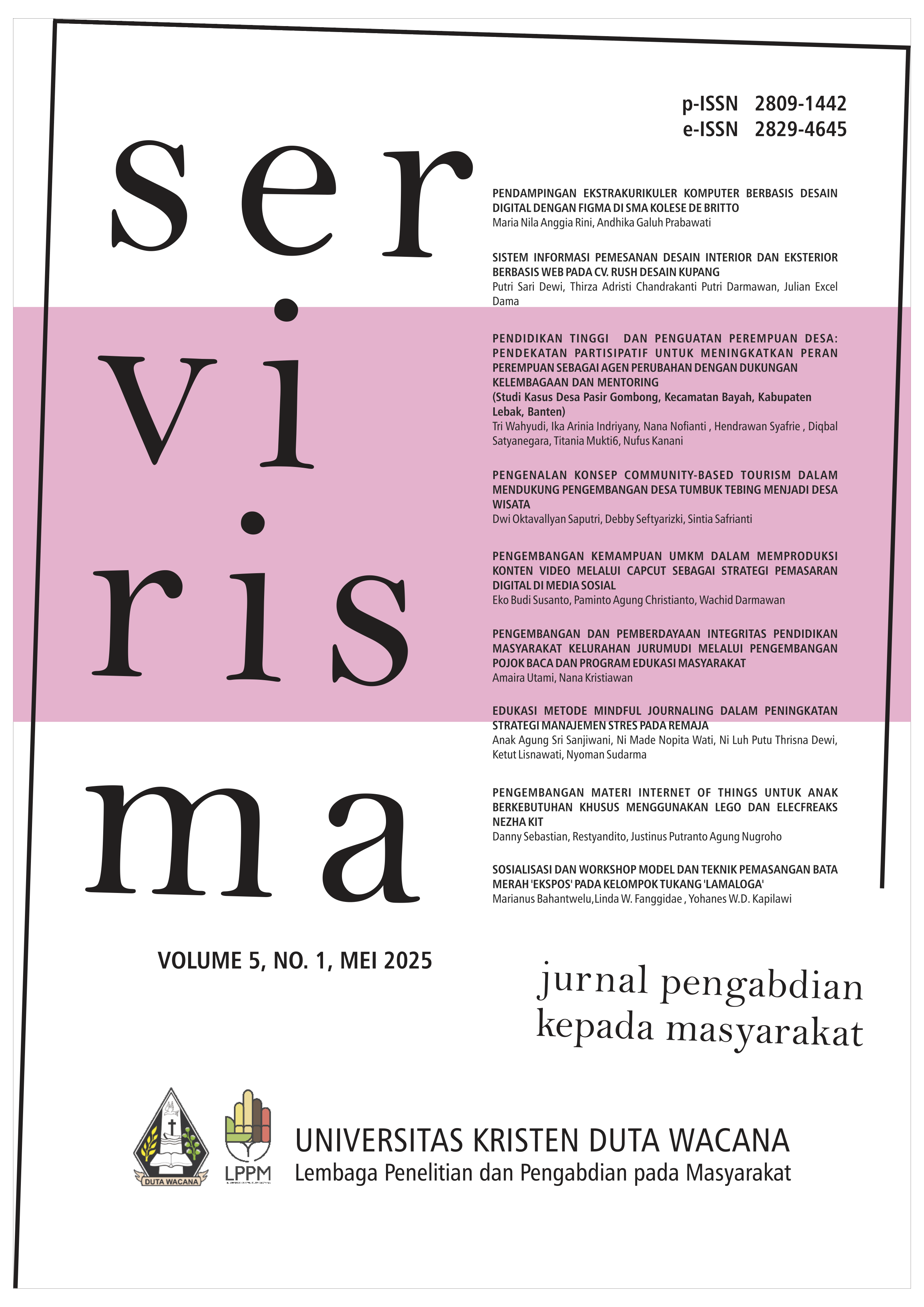
PENGENALAN KONSEP COMMUNITY-BASED TOURISM DALAM MENDUKUNG PENGEMBANGAN DESA TUMBUK TEBING MENJADI DESA WISATA
DOI:
https://doi.org/10.21460/servirisma.2025.51.90Keywords:
Community-based tourism, tourist village, tourism, Tumbuk TembingAbstract
An attractive tourist village is a village that has its uniqueness and characteristics, both from its natural beauty, and culture and also the potential of its human resources. The concept of a tourist village will have a positive impact on a village in preserving the nature and culture of the village and requires community participation so that the community itself has a high sense of ownership and feels the benefits of the existence of a tourist village. Tumbuk Tebing Village is a village that is starting to pioneer in making this area a tourist village, starting to explore the existing tourism potential and introducing it to the tourism industry. The management of a locally-based tourist village requires the concern and participation of the community itself always to innovate and be creative in developing their village area which is used as a tourist village. This community service is carried out by providing initial knowledge related to tourism villages, especially seeing the potential in the Tumbuk Tebing Village Area, South Bengkulu Regency, including beaches with white rocks, rice fields, habitat for white stork colonies, swamp birds, and a strong rural environment that can be packaged in the concept of Community-based Tourism, conducting question and answer discussions, and conducting surveys on attractions, accessibility, and existing facilities. This community service activity is expected to help Tumbuk Tebing Tourism Village, South Bengkulu Regency, in realizing becoming a tourist destination.
References
Abdulhaji, S., & Yusuf, I. S. Hi. (2017). Pengaruh Atraksi, Aksesibilitas dan Fasilitas Terhadap Citra Objek Wisata Danau Tolire Besar di Kota Ternate. Humano: Jurnal Penelitian, 7(2), 134–148. https://doi.org/10.33387/HJP.V7I2.317
Arida, I. N. S., & Pujani, LP. K. (2017). Kajian Penyusunan Kriteria-Kriteria Desa Wisata Sebagai Instrumen Dasar Pengembangan Desawisata. Jurnal Analisis Pariwisata, 17(1), 1–9.
Arifin, A. P. R. (2017). Pendekatan Community Based Tourism dalam Membina Hubungan Komunitas di Kawasan Kota Tua Jakarta. Jurnal Visi Komunikasi, 16(01), 111–130.
Koniherawati, Nugroho, G. D. A., Nathanael, M. A., & Madyaningrana, K. (2024). Perancangan Cenderamata Sebagai Branding Desa Wisata, Kampung Satwa Kedung Banteng, Moyudan, Yogyakarta. Servirisma, 4(2), 87–94. https://doi.org/10.21460/servirisma.2024.42.72
R Basiya, & Rozak, H. A. (2012). Kualitas Daya Tarik Wisata, Kepuasan, dan Niat Kunjungan Kembali Wisatawan Mancanegara di Jawa Tengah. Jurnal Ilmiah Dinamika Kepariwisataan, 11(2), 1–12. https://unisbank.ac.id/ojs/index.php/pdk1/article/view/1715
Satato, Y. R., Yuliamir, H., & Rahayu, E. (2019). Potensi Wisata Kampung PelangiSebagai Daya Tarik Wisata. Jurnal Ilmiah Ekonomi Dan Bisnis, 12(1), 63–70. http://journal.stekom.ac.id/index.php/E-Bisnis■page63
Suchaina. (2014). Pengaruh Kualitas Fasilitas Sarana dan Prasarana Terhadap Peningkatan Jumlah Pengunjung Wisata Danau Ranu Grati. Jurnal Psikologi : Jurnal Ilmiah Fakultas Psikologi Universitas Yudharta Pasuruan, 2(2), 89–109. https://doi.org/10.35891/JIP Undang-Undang Republik Indonesia Nomor 10. Tahun 2009 Tentang Kepariwisataan
Widiyarta, A., Hakim, M. B. A., Setyaningrum, M. D., & Tantriani. (2021). Strategi Pengembangan Desa Wisata Migas di Geopetroleum Teksas Wonocolo Kabupaten Bojonegoro. Jurnal Syntax Admiration, 2(5), 746–761. https://www.jurnalsyntaxadmiration.com/index.php/jurnal/article/view/225/359
Zakaria, F., Suprihardjo, D., Perencanaan, J., & Teknik, F. (2014). Konsep Pengembangan Kawasan Desa Wisata di Desa Bandungan Kecamatan Pakong Kabupaten Pamekasan. JURNAL TEKNIK POMITS, 3(2), 2337-3520.
Downloads
Published
How to Cite
Issue
Section
License
Copyright (c) 2025 Dwi Oktavallyan Saputri, Debby Seftyarizki, Sintia Safrianti

This work is licensed under a Creative Commons Attribution-NonCommercial-NoDerivatives 4.0 International License.
Authors who publish articles in SERVIRISMA agree on the following rules:
1. The author grants non exclusive royalty free rights, and is willing to publish articles online and complete (full access). With such rights SERVIRISMA reserves the right to save, transfers, manages in various forms, maintains and publishes articles while keeping the author's name as the copyright owner.
2. Each author contained in the article has contributed fully to the substance and intellectual, and is accountable to the public. If in the future there is a copyright infringement notification then this will be responsibility of the author, not SERVIRISMA .