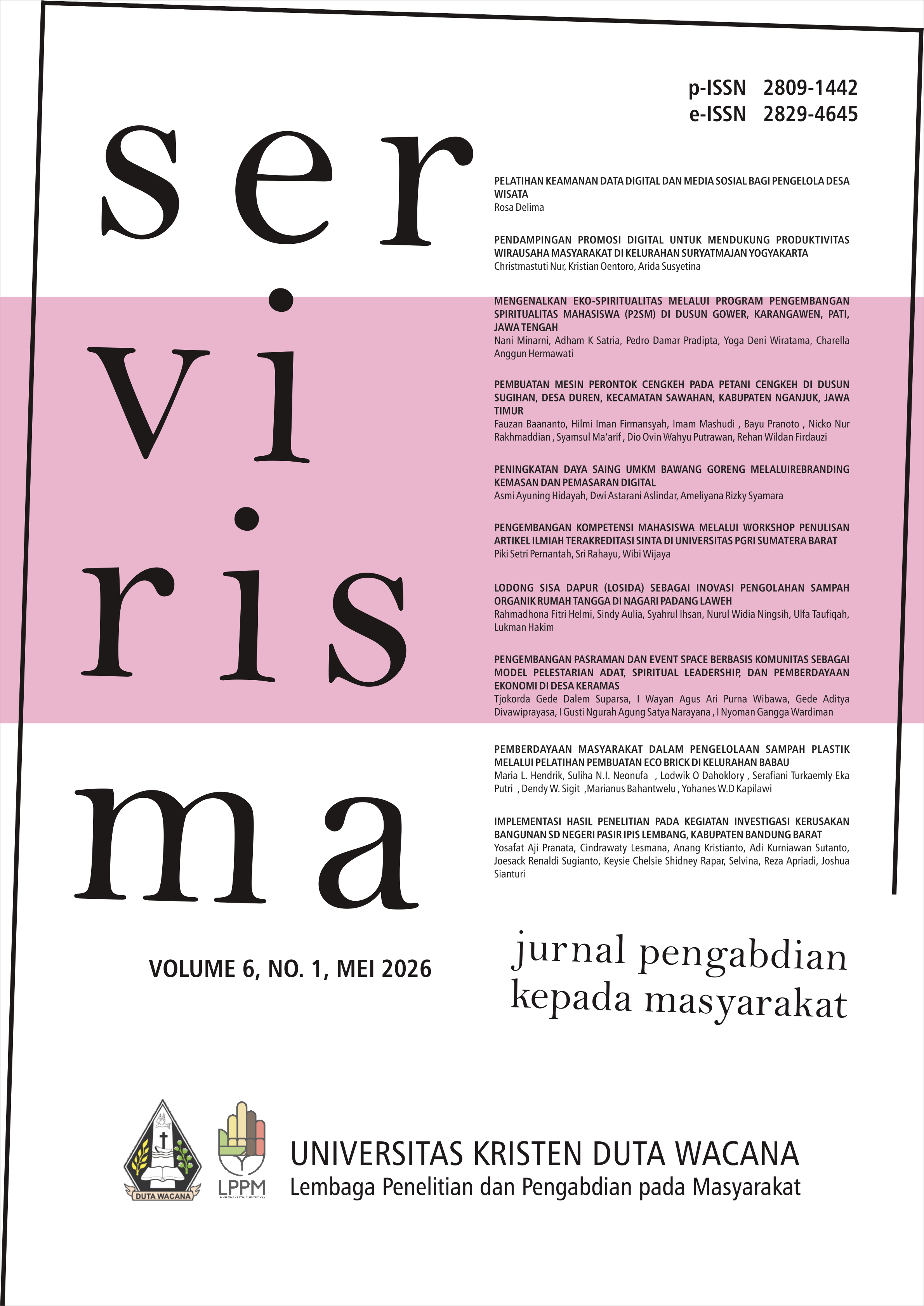
LODONG SISA DAPUR (LOSIDA) SEBAGAI INOVASI PENGOLAHAN SAMPAH ORGANIK RUMAH TANGGA DI NAGARI PADANG LAWEH
DOI:
https://doi.org/10.21460/servirisma.2026.61.135Keywords:
community service, KKN, LOSIDA, organic compost, TOGAAbstract
The problem of household organic waste accumulation is a serious challenge in Nagari Padang Laweh, Sungai Tarab District, Tanah Datar Regency, West Sumatra. Most residents dispose of kitchen waste directly into the surrounding environment without processing, which has an impact on pollution and health risks. Through community service activities within the Real Work Lecture (KKN) program at Padang State University in 2025, an appropriate technology called Lodong Sisa Dapur (LOSIDA) was introduced, namely an organic waste composting system using pipes/paralon as a fermentation medium. The implementation method included socialization, training, and Taman Obat Keluarga (TOGA) competitions with a participatory approach to residents. The results of the activity showed an increase in community understanding and skills in managing organic waste into liquid and solid compost that can be directly used to fertilize plants. LOSIDA technology has proven to be easy to implement, inexpensive, environmentally friendly, and relevant for implementation in rural areas. This activity also succeeded in increasing public awareness of the importance of household-based waste management, while supporting the achievement of the Sustainable Development Goals (SDGs), especially goals 11 and 13.
References
Agustyarini, Y. (2024). Pemberdayaan Masyarakat Melalui Pembuatan Pupuk Kompos Cair Dan Pengelola Bank Sampah Di Desa Pandankrajan. JURNAL PENGABDIAN MASYARAKAT BANGSA, 1(12), 3566–3574.
Alam, Y., Harliana, Haryuni, N., & Oktaviani, R. T. (2024). Pengelolaan Limbah Rumah Tangga Berbasis Komunitas untuk Produksi Pupuk Kompos Organik. Welfare : Jurnal Pengabdian Masyarakat, 2(4), 748–753.
Bagaskoro, A. D., & Juliandara, L. (2023). Workshop Pengolahan Sampah Rumah Tangga Organik menjadi Pupuk Organik Cair. Prima Abdika: Jurnal Pengabdian Masyarakat, 3(4), 573–579.
Cahyono, M. D., Arnold, M. Y., & Susiati, D. (2023). Pemanfaatan Sampah Organik Rumah Tangga Sebagai Kompos Di Tempat Pembuangan Sampah Terpadu. JURNAL PENGABDIAN MASYARAKAT BANGSA, 1(6), 861–867.
Hidayah, W., Wulandari, D. F., & Pratiwi, W. (2023). Pengolahan Limbah Organik Rumah Tangga Menjadi Kompos Melalui Penerapan Metode Takakura. DITEKSI: JURNAL PENGABDIAN KEPADA MASYARAKAT, 1(2), 131–137.
Indrawan, G. S., Putra, I. N. G., Brasika, I. B. M., Karang, I. W. G. A., Puspitha, N. L. P. R., & Widiastuti. (2022). Pengelolaan Sampah Organik Berbasis Skala Rumah Tangga di Desa Lebih, Gianyar, Bali. BULETIN UDAYANA MENGABDI, 21(3), 261–267.
Nurjazuli, N., Dewanti, N. A. Y., Setiani, O., Joko, T., Rahardjo, M., Wahyuningsih, N. E., Darundiati, Y. H., Budiyono, B., Suhartono, S., & Sulistiyani, S. (2022). Sosialisasi Teknologi Pengolahan Sampak Organik Menjadi Kompos Cair Melalui Pemberdayaan Masyarakat. Journal of Public Health and Community Services, 1(1), 6–14.
Verananda, E., Erinna, T., Devi, Y., & Nadiyah, F. (2022). Pelatihan Pembuatan Kompos Cair dari Limbah Rumah Tangga. JURNAL PERDULI, 03(01), 17–23.
Wardani, Y., Arwanda, B. T., Aulia, M., Putri, K., Ningtiyas, D. W., Dewani, L. L., & Kasyfi, Z. N. (2024). Lodong Sisa Dapur (LOSIDA) sebagai Solusi Pengelolaan Sampah Organik Rumah Tangga. Abdimas Galuh, 6(2), 1793–1800.
Widiati, K. Y., Mulyadi, R., & Adani, R. W. (2022). Pembuatan Kompos Sebagai Upaya Pemanfaatan Sampah Rumah Tangga. ABDIKU: Jurnal Pengabdian Masyarakat Universitas Mulawarman, 1(1), 1–5.
Wikandaru, A., Sihaloho, R. C., Puspita, T. A. R., Novitasari, P. Y., & Sania, K. I. (2024). Pelatihan Pengolahan Sampah Organik Menjadi Kompos bagi Warga Desa Karimunjawa RT03 / RW02. JURNAL PENGABDIAN MASYARAKAT BANGSA, 2(8), 3609–3613.
Downloads
Published
How to Cite
Issue
Section
License
Copyright (c) 2026 Sindy Aulia, Syahrul ihsan, Rahmadhona Fitri Helmi, Ulfa Taufiqah, Lukman Hakim, Nurul Widia Ningsih

This work is licensed under a Creative Commons Attribution-NonCommercial-NoDerivatives 4.0 International License.
Authors who publish articles in SERVIRISMA agree on the following rules:
1. The author grants non exclusive royalty free rights, and is willing to publish articles online and complete (full access). With such rights SERVIRISMA reserves the right to save, transfers, manages in various forms, maintains and publishes articles while keeping the author's name as the copyright owner.
2. Each author contained in the article has contributed fully to the substance and intellectual, and is accountable to the public. If in the future there is a copyright infringement notification then this will be responsibility of the author, not SERVIRISMA .