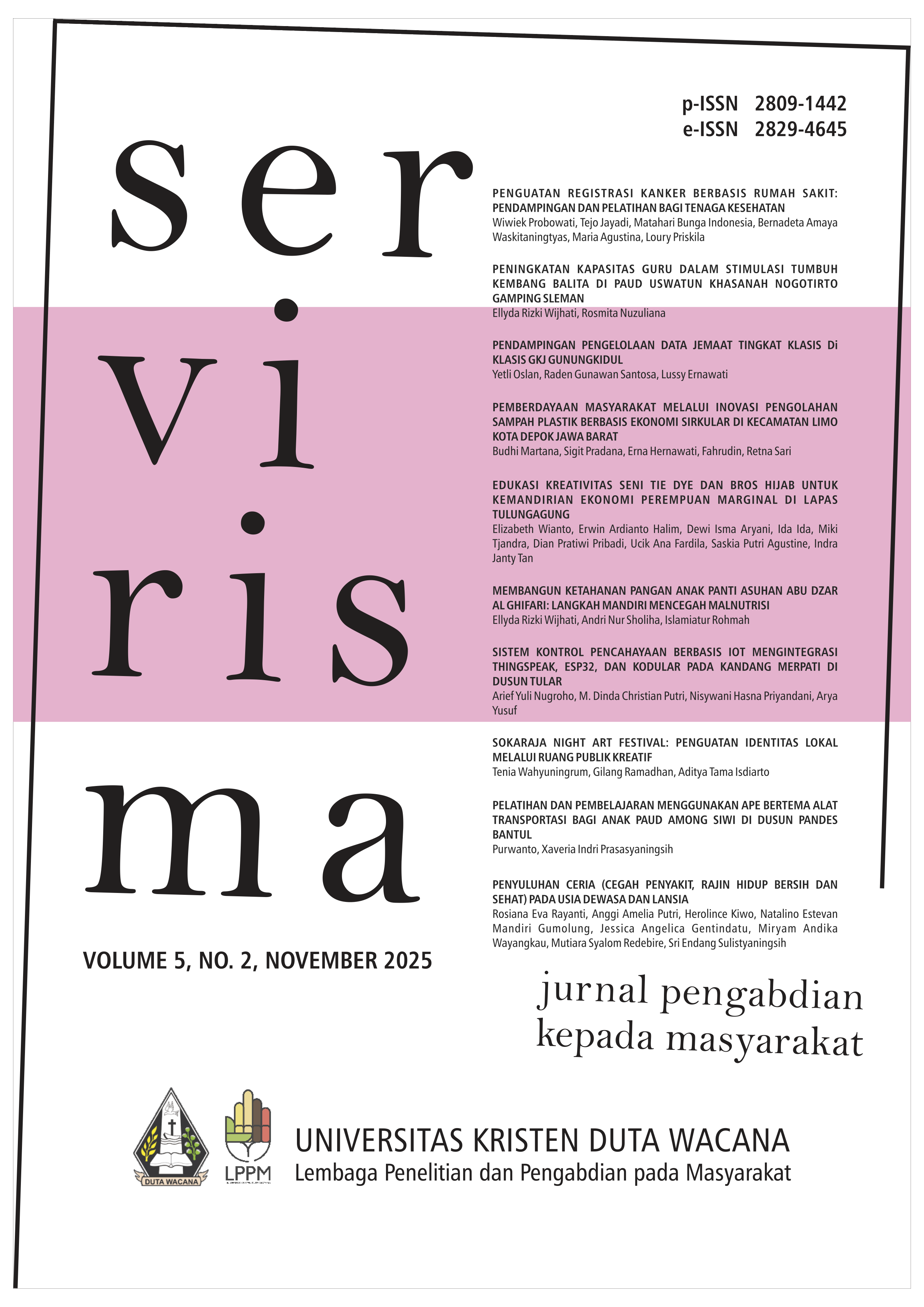
THE BUILDING FOOD SECURITY FOR ORPHANAGE CHILDREN: A SELF-RELIANT STEP TO PREVENT MALNUTRITION
DOI:
https://doi.org/10.21460/servirisma.2025.52.121Keywords:
local food, orphanage, nutrition education, food security, aquaponicsAbstract
Children in orphanages, such as those at the Abu Dzar Al-Ghifari Orphanage, are highly vulnerable due to limited access to nutritional information and inconsistent food supplies. This situation affects their growth and long-term health, highlighting the critical need to strengthen food security within the orphanage environment. This community service research was conducted at the Muhammadiyah Abu Dzar Al Ghifari Orphanage. The five-stage program included balanced nutrition education, food security training, catfish cultivation in gallons using an aquaponic system (catfish and water spinach), utilization of cultivated produce, and an evaluation of food self-sufficiency. The methods employed were discussions, lectures, Q&A sessions, and hands-on practice, with the orphanage management acting as coordinators. Education involving 22 children and 2 caregivers successfully increased the average pretest score from 60 to 80, demonstrating the method's effectiveness. The training in cultivating catfish and water spinach in gallons not only provided sources of protein and vegetables but also empowered participants and utilized plastic waste. Active involvement from caregivers fostered a sense of ownership and program sustainability. This program effectively enhanced nutritional knowledge and food security at the Abu Dzar Al-Ghifari Orphanage, preventing malnutrition, and building sustainable food self-sufficiency through aquaponic innovation.
References
Abdurrohim, L., Suprapto, M. E., & Insani, G. A. (2024). Pemanfaatan Limbah Galon Sebagai Wadah Budidaya Ikan dan Tanaman (Budikdamlon) Sebagai Langkah Pengelolaan Sampah Anorganik di Dusun Jombor, Desa Jetis, Kecamatan Bandungan, Kabupaten Semarang, Jawa Tengah. 2(2), 306–313.
Bello, T. K., & Pillay, J. (2019). An evidence-based nutrition education programme for orphans and vulnerable children: Protocol on the development of nutrition education intervention for orphans in Soweto, South Africa using mixed methods research. BMC Public Health, 19(1), 1–10. https://doi.org/10.1186/s12889-019-6596-5
FAO. (2020). The State of Food Security and Nutrition in The World 2020. Transforming Food Systems for Affordable Healthy Diets. In The State of Food Security and Nutrition in the World 2020. FAO IFAD UNICEF WFP WHO.
Fatimah, S., Zulfikar, M. H., & Mansir, F. (2021). Pemberdayaan Panti Asuhan Melalui Pengelolaan Kegiatan Pada Bidang Lingkungan Dan Pertanian Di Panti Asuhan Putri Muhammadiyah Pakem Yogyakarta. Bakti Banua: Jurnal Pengabdian Kepada Masyarakat, 2(2), 29–37. https://doi.org/10.35130/bbjm.v2i2.218
Fatmawati, N., Zulviana, Y., & Ariendha, D. S. R. (2024). Kandungan Olah Lele (Clarias Batrachus) Terhadap Status Gizi (Literatur Review). Journal of Fundus, 4(2), 29–35. https://journal.ikmedia.id/index.php/jilpi/article/view/24
Goenawan, H., Veronica, F., Sylviana, N., & Nurhayati, T. (2019). Peningkatan Pengetahuan Mengenai Gizi Seimbang pada Siswa SD di Jatinangor. Journal of Chemical Information and Modeling, 53(9), 1689–1699. https://jurnal.unpad.ac.id/pkm/article/download/19975/9533
Güven, Y., & Öncü, E. (2022). The relationship between junk food consumption, healthy nutrition, and obesity among children aged 7 to 8 years in Mersin, Turkey. Nutrition Research, 103, 1–10. https://doi.org/10.1016/j.nutres.2022.03.004
Jha, C., & Singh, V. (2023). Effect of Interactive Nutrition and Health Education Intervention on Knowledge and Practices of Indian School Children and Their Parents. Indian Journal of Human Development, 17(3), 507–517. https://doi.org/10.1177/09737030241244578
Kemenkes RI. (2023). Buku Saku Hasil Studi Status Gizi Indonesia (SSGI) 2022. Kementerian Kesehatan RI.
Khater, E. S., Bahnasawy, A., Ali, S., Abbas, W., Morsy, O., & Sabahy, A. (2023). Study on the plant and fish production in the aquaponic system as affected by different hydraulic loading rates. Scientific Reports, 13(1), 1–10. https://doi.org/10.1038/s41598-023-44707-1
Marchianti, A. C. N., Rachmawati, D. A., Astuti, I. S. W., Raharjo, A. M., & Prasetyo, R. (2022). the Impact of Knowledge, Attitude and Practice of Eating Behavior on Stunting and Undernutrition in Children in the Agricultural Area of Jember District, Indonesia. Jurnal Berkala Epidemiologi, 10(2), 140–150. https://doi.org/10.20473/jbe.v10i22022.140-150
Maucieri, C., Nicoletto, C., Junge, R., Schmautz, Z., Sambo, P., & Borin, M. (2018). Hydroponic systems and water management in aquaponics: A review. Italian Journal of Agronomy, 13(1), 1–11. https://doi.org/10.4081/ija.2017.1012
Morrison, A. K., Glick, A., & Yin, H. S. (2019). Health Literacy: Implications for Child Health. Pediatrics In Review, 40(6), 263–277. https://doi.org/10.1542/pir.2018-0027
Murimi, M. W., Moyeda-Carabaza, A. F., Nguyen, B., Saha, S., Amin, R., & Njike, V. (2018). Factors that contribute to effective nutrition education interventions in children: a systematic review. Nutrition Reviews, 76(8), 553–580. https://doi.org/10.1093/nutrit/nuy020
Mursalat, A., AR, T., Thamrin, N. T., Irwan, M., Razak, R. R., & Asra, R. (2023). Pemberdayaan Panti Asuhan Melalui Edukasi Aeroponik dalam Mewujudkan Kemandirian Pangan. Studi Kasus Inovasi Ekonomi, 07(02), 109–118. http://ejournal.umm.ac.id/index.php/skie
Pramono, A., Puruhita, N., & Fatimah Muis, S. (2018). Pengaruh pendidikan gizi terhadap pengetahuan dan sikap tentang gizi anak Sekolah Dasar. Jurnal GIzi Indonesia, 3(1), 1858–4942.
Putri, B., Handrias, K., Putri, A., Erwanda, N., Mahda, E., Putri, G., & Wandani, A. R. (2023). Edukasi Makanan Serta Jajanan Sehat, Halal, dan Bergizi dalam Upaya Meningkatkan Kesadaran Anak Panti Asuhan. Jurnal Magistrorum Et Scholarium, 03(01), 103–112.
Rahmadhayanti, R., Fathurrahman, & Mas’odah, S. (2023). Pengaruh Penggunaan Media Video Terhadap Pengetahuan Dan Sikap Pemilihan Makanan Jajanan Pada Anak Sekolah. Jurnal Riset Pangan Dan Gizi, 5(2), 10–19. https://doi.org/10.31964/jr-panzi.v5i2.161
Rahmiati, B. F., Naktiany, W. C., Hasbullah, & Wijaya, F. W. (2022). Pendampingan Percepatan Penurunan Stunting Melalui Pemberdayaan Masyarakat untuk Mengolah Kelimpahan Lele di Desa Batu Kumbung. Journal Ilmiah Pengabdian Dan Inovasi, 1(2), 153–164. https://journal.ikmedia.id/index.php/jilpi/article/view/24
Ridwan, I., & Wahyudi, D. (2020). Pemberdayaan Perempuan Melalui Pelatihan Pengolahan Ikan Lele Dan Diversifikasi Produk Di Umkm Mutiara Timur. Jurnal Dedikasi Masyarakat, 3(2), 2598–7984.
Sujarwo, S., Charli, L., & Marsehan, A. (2024). Aquaponik Sederhana Dalam Meningkatkan Keterampilan dan Ekonomi Masyarakat 3T. JURNAL CEMERLAN: Pengabdian Pada Masyarakat, 7(1), 88–97. https://doi.org/10.31540/jpm.v7i1.3193
Syafruddin, S., Sudiyarti, N., Ismawati, I., Haryadi, W., & Kurniawansyah, K. (2019). Budidaya Terintegrasi Lele dan Kangkung Dalam Mewujudkan Kemandirian Pangan Masyarakat. Jurnal Pengembangan Masyarakat Lokal, 2(2), 85–90.
UNICEF, WHO, & World Bank Group. (2021). Levels and trends in child malnutrition. In World Health Organization. https://www.who.int/publications/i/item/9789240025257
Verjans-Janssen, S. R. B., van de Kolk, I., Van Kann, D. H. H., Kremers, S. P. J., & Gerards, S. M. P. L. (2018). Effectiveness of school-based physical activity and nutrition interventions with direct parental involvement on children’s BMI and energy balance-related behaviors – A systematic review. PLOS ONE, 13(9), e0204560. https://doi.org/10.1371/journal.pone.0204560
Wang, Y. J., Yang, T., & Kim, H. J. (2023). pH Dynamics in Aquaponic Systems: Implications for Plant and Fish Crop Productivity and Yield. Sustainability (Switzerland), 15(9), 1–20. https://doi.org/10.3390/su15097137
Zidni, I., Iskandar, I., Rizal, A., Andriani, Y., & Ramadan, R. (2019). The Effectiveness of Aquaponic Systems with Different Types of Plants on the Water Quality of Fish Culture Media. Jurnal Perikanan Dan Kelautan, 9(1), 81. https://doi.org/10.33512/jpk.v9i1.7076
Downloads
Published
How to Cite
Issue
Section
License
Copyright (c) 2025 Ellyda Rizki Wijhati, Andri Nur Sholihah, Islamiatur Rohmah

This work is licensed under a Creative Commons Attribution-NonCommercial-NoDerivatives 4.0 International License.
Authors who publish articles in SERVIRISMA agree on the following rules:
1. The author grants non exclusive royalty free rights, and is willing to publish articles online and complete (full access). With such rights SERVIRISMA reserves the right to save, transfers, manages in various forms, maintains and publishes articles while keeping the author's name as the copyright owner.
2. Each author contained in the article has contributed fully to the substance and intellectual, and is accountable to the public. If in the future there is a copyright infringement notification then this will be responsibility of the author, not SERVIRISMA .